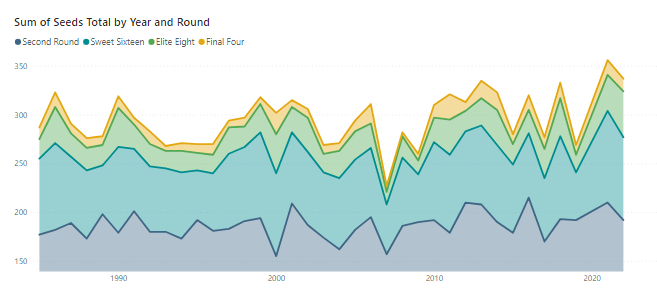
With the Final Four coming up this weekend and my Baylor Bears out of title contention, I had a bit more time on my hands and so decided to dive into some historical data on March Madness. This year, I felt like there was upset after upset (UNC over Baylor – ouch, the incredible success of Saint Peter’s, and Kansas being the only 1 seed remaining to name a few) so I decided to investigate and see just how mad this March really was.
Here is a link to a Power BI dashboard that goes along with this post. On mobile, it is best viewed in landscape mode and zooming in to see the features.
I came up with a metric to track the volatility of the March Madness tournament: Sum of Seeds. Each round has its own value, this is taken by summing the team seeds remaining for each round. For example, the first round will always have 544 as its sum of seeds. In an ideal world, where there are no upsets and the favorite team always wins, round two will have 144, the Sweet Sixteen will have 40, the Elite Eight will have 12, the Final Four will be 4, and the National Championship will have 2. For the rest of this post, we will call this “ideal value” each round’s Norm. However, as we all know, we do not live in an ideal world. This is easily seen by the fact that two 1-seeds have faced each other only 8 times in the championship since 1985, showing that at least one lower rated seed defeated a higher rated opponent along the way. But just how mad was this March compared to previous years? Let’s find out.
Before we get started, one more advantage of the sum of seeds should be noted. If a round has a large sum of seeds, that implies that the previous round had more lower seeds winning games and a larger number of upsets. With a high sum of seeds, two outcomes occur: first, more upsets which leads to an even larger sum of seeds compared to that round’s Norm and second, with a potentially large delta between the teams playing, more favorites win and so the sum of seeds decreases substantially.
“Upsets are defined as when the winner of the game was seeded five or more places lower than the team it defeated.”
NCAA
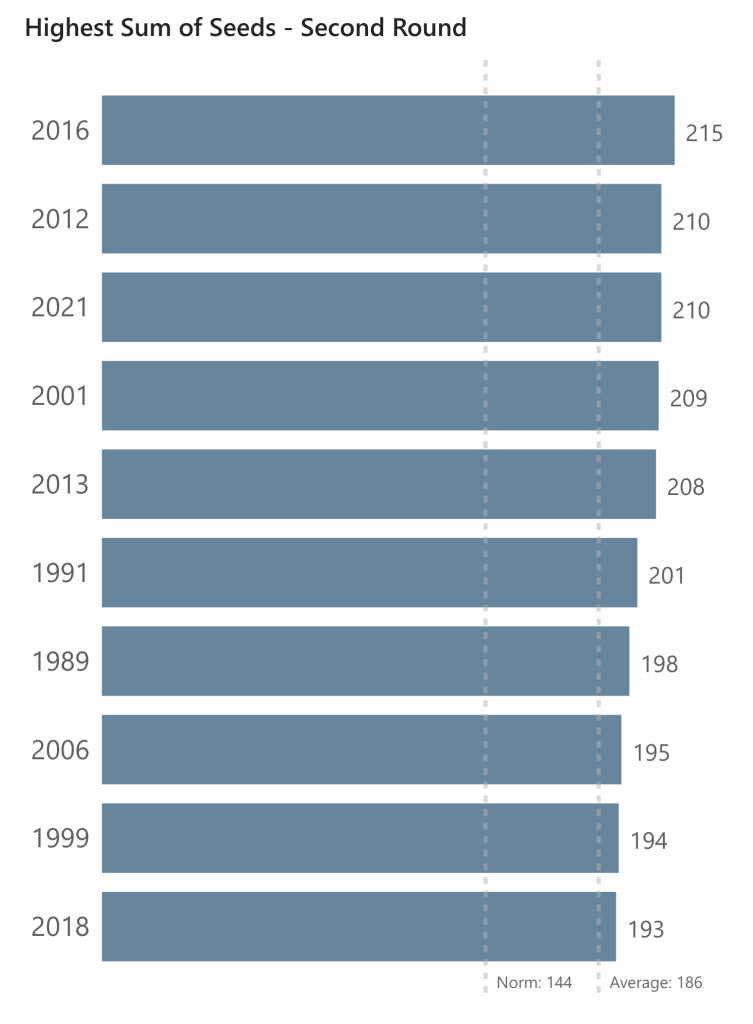
As mentioned, the Second Round’s Norm is 144 for its sum of seeds. This year, the value was 192, 48 higher than the Norm. That may seem like a large delta but it is just above the average. Below, you can see a chart breaking down the top 10 highest sum of seeds since 1985, with the top value being 2016. That year, if you remember, was when there were seven upsets in the first round, including 15-seed Middle Tennessee over 2-seeded Michigan State and, regrettably for my Bears, 12-seed Yale over 5-seed Baylor. Per the NCAA, “Upsets are defined as when the winner of the game was seeded five or more places lower than the team it defeated.” Contrast that to 2000, which seen below has the lowest sum of seeds in the Second Round and only had one upset.

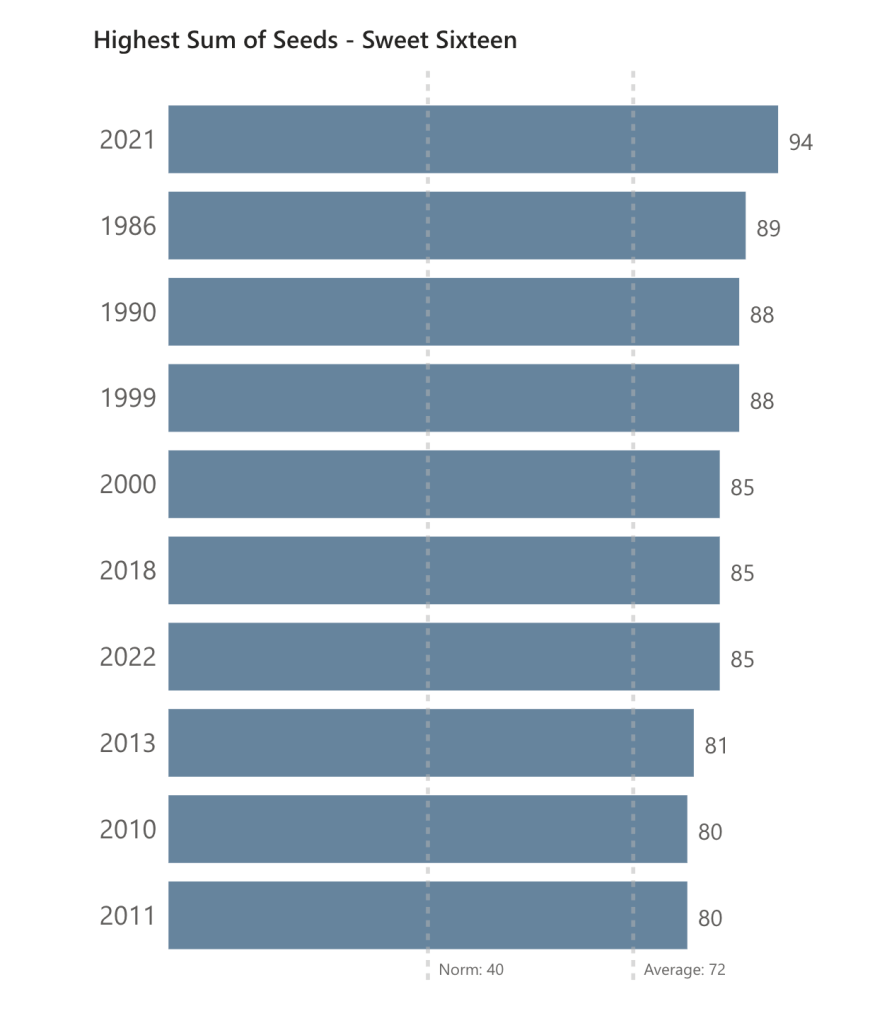
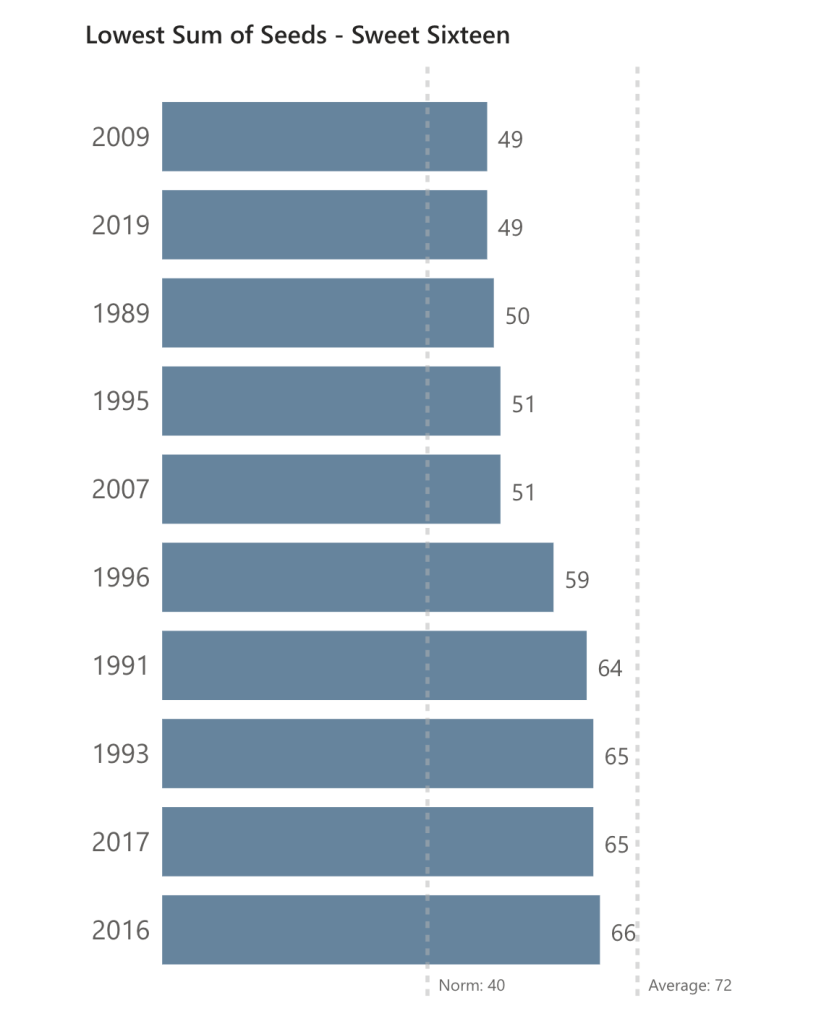
The Sweet Sixteen (Norm: 40) this year had a sum of seeds value of: 85. Note that the percent difference from the Norm and this round is 112.5%. This shows that much more madness occurred during the second round than the first (as the percent difference from the Norm in the second round was only 33.3%). There were five upsets in the second round this year and each one was quite substantial, even if one of them stung a bit. However, even with that amount of tumult, it did not even crack the top five. But two interesting years are 2016 and 2021. These show the dichotomy of what a large Sum of Seeds can result in the following round. First, 2016 had the highest second round Sum of Seeds, as noted above. However, after a majority of favorites won, it had the 10th lowest value in the Sweet Sixteen. Contrast that to 2021, which had the third highest Sum of Seeds in the second round, and after a number of upsets that round, ended up with the highest value in the Sweet Sixteen by a substantial margin.
The Elite Eight’s (Norm: 12) sum of seeds was where this year’s madness truly came to light. With a value of 47, seven points higher than the previous highest value, 2022 had the craziest Sweet Sixteen round on record. (Remember: a round’s sum of seeds is indicative of the previous round’s results.) There was only one upset: Saint Peter’s over Purdue, allowing them to become the first 15 seed to make it to the Elite Eight but many other factors came together. First, two out of the three remaining 1 seeds lost. Second, a 10 seed played an 11 seed which has only happened a total of four times (all, coincidentally, in the past decade). And finally, an 8 seed moved onto the Elite Eight which has only happened nine times, North Carolina being two of those nine. It should also be noted that for the first time in this post, we have almost had the Norm in one year: 2007. That year, all 1-seeds, three 2-seeds, and one 3-seed made it to the Elite Eight, making that year one of the most predictable (and not quite so mad) March’s on record.
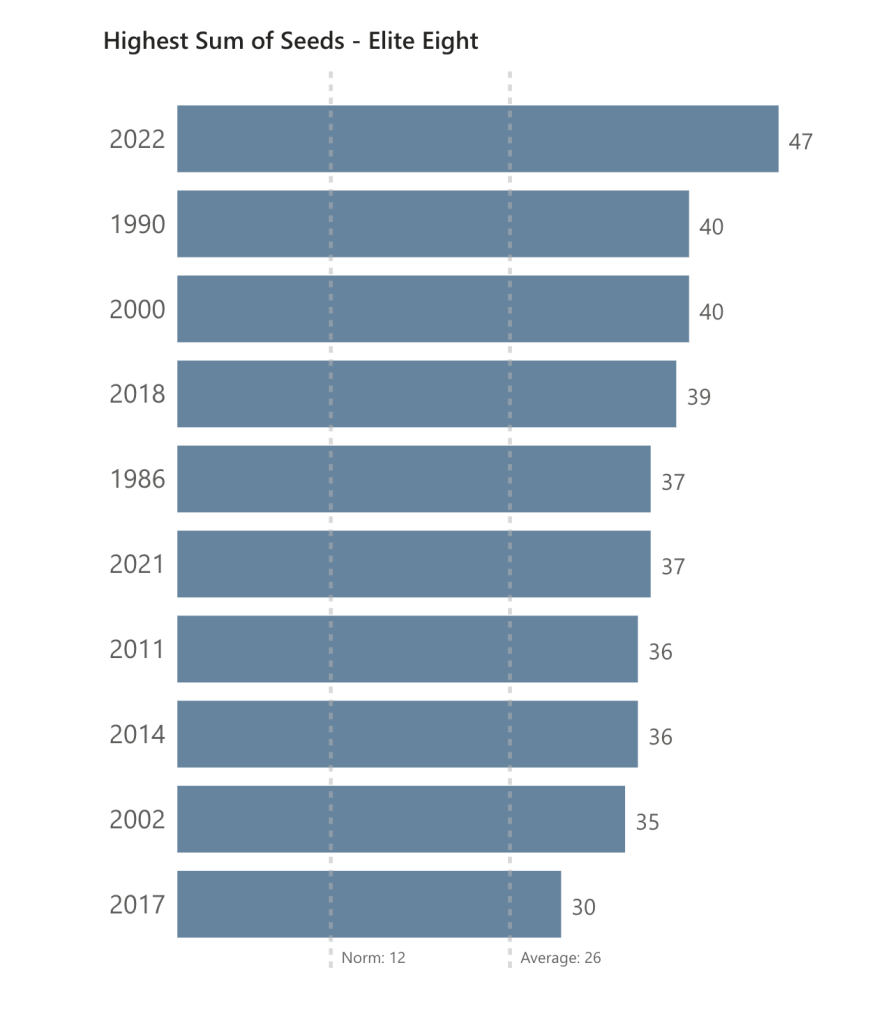
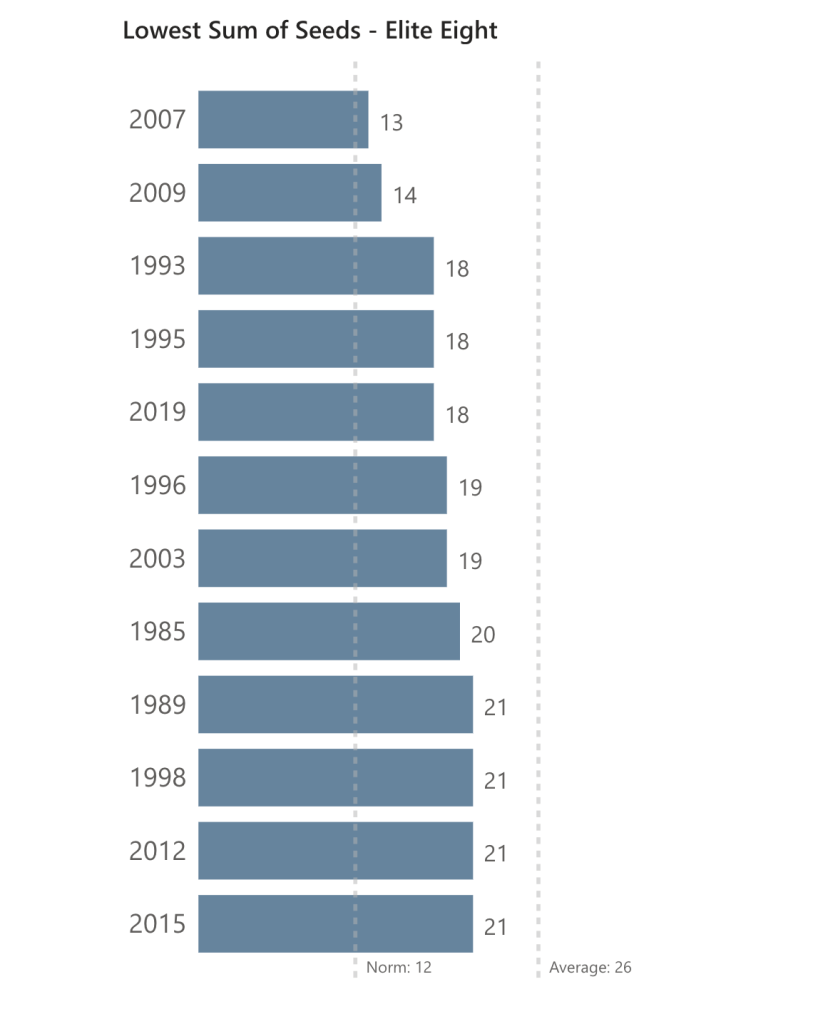
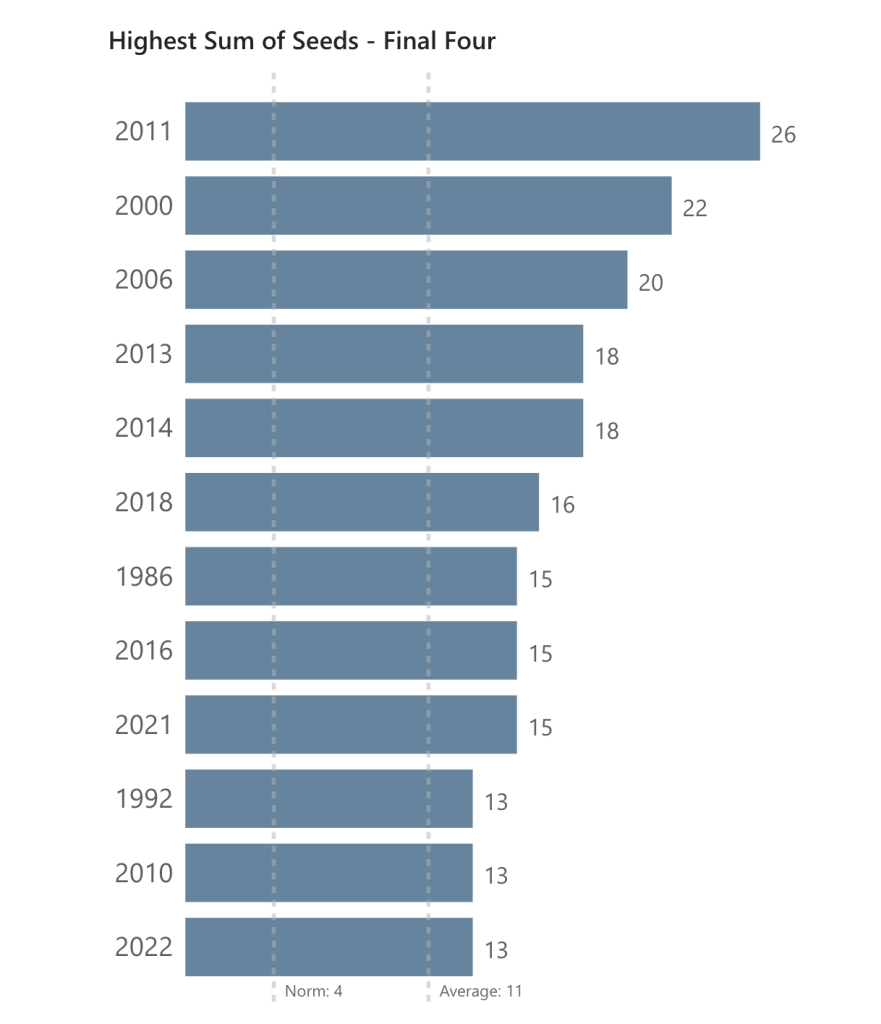
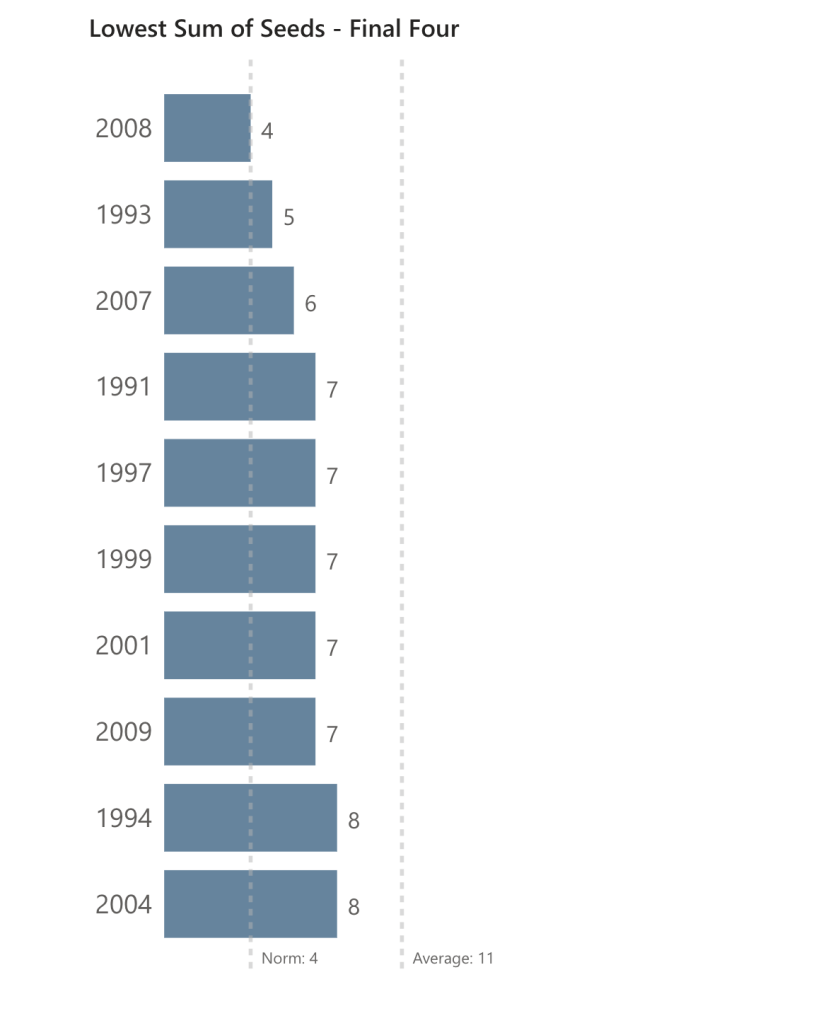
Finally, the Final Four (Norm: 4). As we know, what goes up must come down and that was certainly the case this year. With a Final Four sum of seeds value of 13, 2022 dropped to just above the average and nearly out of the top 10. As mentioned, this is what can happen when a round has a very large sum of seeds: the next round will more than likely trend towards the average as, eventually, the higher seeds start to win. However, that does not always happen, as seen in 2011 which had a relatively average start to the tournament (in terms of sum of seeds) but started to pick up steam in the Elite Eight and Final Four. That year, 11-seed Virginia Commonwealth (VCU) lost to 8-seed Butler in the Final Four while on the other side of the bracket, 3-seed UConn played 4-seed Kentucky. Conversely, we finally have a year that matched the Norm: 2008 found all four 1-seeds making it to the Final Four. This is the one and only time that it has happened since 1985.
I will update this post with the National Championship’s sum of seeds after the Final Four games play out. However, I will comment that this year’s tournament has truly been one of the maddest March’s on record. With a combined total sum of seeds (Second Round through Final Four) of 337, this year is currently tied for fourth highest total. If Kansas and Duke win, which would result in the lowest championship sum of seeds, then the total would reach 340, tying this year for second all-time. However, if either UNC or Villanova wins, this year would hold second outright.
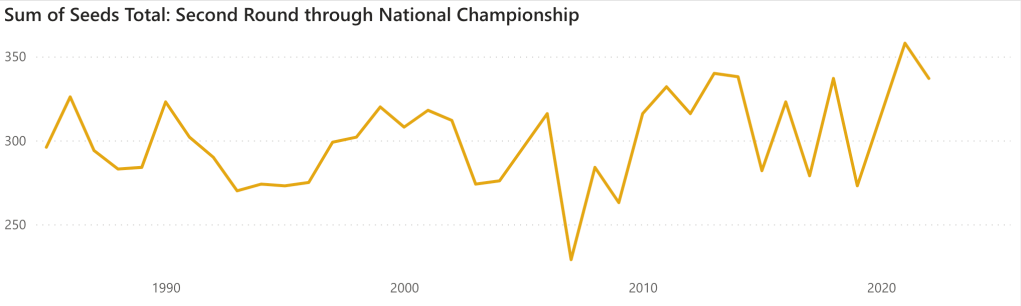
The highest total sum of seeds? Last year at a whopping 358. Who won the most mad March of them all? Oh yes – the Baylor Bears. Sic’em.
 Boles Data Consulting